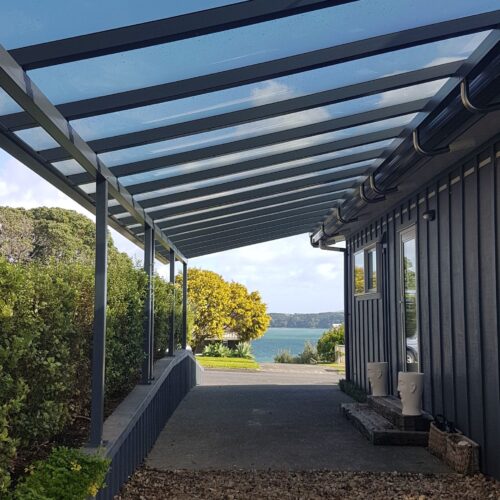
The moment your home stops at the back door, you've missed one of its greatest opportunities.
When we think about the rooms in our home, we rarely think about the walls.
A kitchen isn't defined by its cabinetry.
A lounge isn't remembered for the plasterboard.
A dining room isn't simply a collection of timber, paint and flooring.
They're rooms because of what happens within them. They're places where families gather, conversations unfold, children play and everyday life quietly takes place.
Yet the moment we step outside, our language changes.
We stop talking about rooms.
Instead, we talk about decks, patios, pergolas and courtyards.
It's an interesting shift.
Because those words describe what the space is built from rather than how it's experienced.
Perhaps that's why so many outdoor spaces never quite become part of the home.
Thinking Differently
For decades we've treated outdoor areas as additions to the house rather than extensions of the way we live.
The conversation usually begins with measurements.
How large should the deck be?
What material should we use?
Where will the barbecue sit?
They're all sensible questions, but they assume we've already answered the most important one.
How do we actually want to live in this space?
Imagine approaching your lounge the same way.
You wouldn't begin by choosing flooring or selecting furniture.
You'd begin by imagining the life you wanted the room to support.
Would it be somewhere to relax after work?
A place where family naturally gathers?
Somewhere to entertain friends?
Only once that picture became clear would the design begin to take shape.
Perhaps outdoor spaces deserve the same thinking.
Another Room, Not Another Project
The most successful outdoor spaces don't feel like projects that have been completed.
They feel like rooms that have been discovered.
Places where morning coffee naturally tastes better.
Where a quiet afternoon somehow stretches into dinner.
Where children wander in and out without thinking about whether they're inside or outside.
Where friends instinctively gather because that's simply where the conversation belongs.
None of those moments happen because of the decking.
Or the furniture.
Or even the shelter overhead.
They happen because the space has quietly earned its place in everyday life.
That's the difference between having a deck...
...and having another room.
Design Begins With Behaviour
At Flexiroof we've started looking at outdoor living through a different lens.
Rather than asking, "What should we build?" we prefer to ask, "How do we want people to live?"
It's a subtle change, but it transforms every decision that follows.
When behaviour becomes the starting point, the design naturally begins serving people instead of simply filling space.
A family who dreams of lingering over breakfast every weekend will design differently from one that loves entertaining neighbours on warm evenings.
Someone who works from home will value different things from a family with young children.
The structure hasn't changed.
The purpose has.
And purpose is what gives a room its identity.
The Four Elements of an Outdoor Room
As we've explored this idea, four qualities seem to appear again and again in outdoor spaces that people genuinely love.
The first is shelter. Not because we need to hide from the weather, but because weather should no longer decide whether the space can be enjoyed.
The second is comfort. Comfortable spaces invite people to stay. They become places where time quietly slips away rather than somewhere people simply pass through.
The third is connection. The best outdoor rooms don't feel detached from the home. They feel like the home simply continues beyond the back door.
Finally, every successful outdoor room has purpose. Whether it's sharing meals, reading a book, working from home or gathering with family, the space exists to support a particular way of living.
Remove any one of these elements and the experience begins to weaken.
Bring them together and something remarkable happens.
The outdoor space stops feeling like "outside".
It simply becomes another room.
A Different Measure of Success
Perhaps we've been measuring outdoor spaces the wrong way all along.
Success isn't determined by the size of the deck.
Or the cost of the project.
Or even how impressive it looks the day construction finishes.
Success is measured years later.
It's measured by how naturally the space becomes woven into everyday life.
By the number of family dinners shared there.
By quiet mornings with a coffee.
By children playing while dinner is prepared.
By friends who always seem to drift outside without anyone suggesting it.
That's when an outdoor area becomes something far more valuable than another project.
It becomes part of the home.
A Thought From Flexiroof
At Flexiroof, we don't believe we're simply helping people create covered outdoor spaces.
We believe we're helping people create another room.
One that happens to exist beneath the sky.
Because the greatest outdoor spaces aren't remembered for the materials they were built from.
They're remembered for the lives they helped shape.
The Lighthouse Principle
A room isn't defined by walls. It's defined by the life that happens within it.
The most successful outdoor rooms don't ask people to change their behaviour.
They quietly become somewhere people naturally choose to be.
Looking Ahead
If an outdoor room is defined by the life it supports, what role does the weather play?
In our next article, we'll explore why the best outdoor spaces aren't designed in spite of the weather—but in partnership with it.
